
Key statistics
Satellite NOAA 11 at a glance.
Uptime
13594
Days in orbit
Revolutions
≈ 14.2
Per day
Orbit
SSO
Sun Synchronous Orbit
Inclination
98.6
Latest
Satellite identification and parameters
Extended collection of information and parameters for NOAA 11.
Object identification
Identified? True
Debris? False
Object name: NOAA 11
International designator: 1988-089A
Object number (NORAD): 19531
Object ID (CCSDS): 19531
Country: UNITED STATES OF AMERICA (US)
Current information (Y/N): Y
RCS size: LARGE
Orbital parameters
Period: 101.709 minutes
Inclination: 98.5974 deg
SMA: 7217.739 km
Apoapsis: 848.305 km
Periapsis: 830.903 km
RAAN: 293.3479 deg
Eccentricy: 0.00120545
Argument of periapsis: 112.2018 deg
Mean anomaly: 248.0437 deg
Mean motion: 14.15797072 rev/day
Mean motion (dot): 0.00000133 rev/day2
B* drag term: 0.000088890745 1/REarth
Two-line elements (TLE)
Creation date: Dec. 12, 2025, 10:14 a.m.
Reference frame: TEME
Reference center: EARTH
Epoch: Dec. 12, 2025, 7:06 a.m. UTC
TLE line 0: 0 NOAA 11
TLE line 1: 1 19531U 88089A 25346.29615288 .00000133 00000-0 88891-4 0 9998
TLE line 2: 2 19531 98.5974 293.3479 0012055 112.2018 248.0437 14.15797072921034
Live tracking on map
Real-time ground track for satellite NOAA 11.
In-orbit conjunctions
A list of the most updated potential collisions computed for object NOAA 11.
Associated space launch
Fourth generation NOAA meteorological satellite
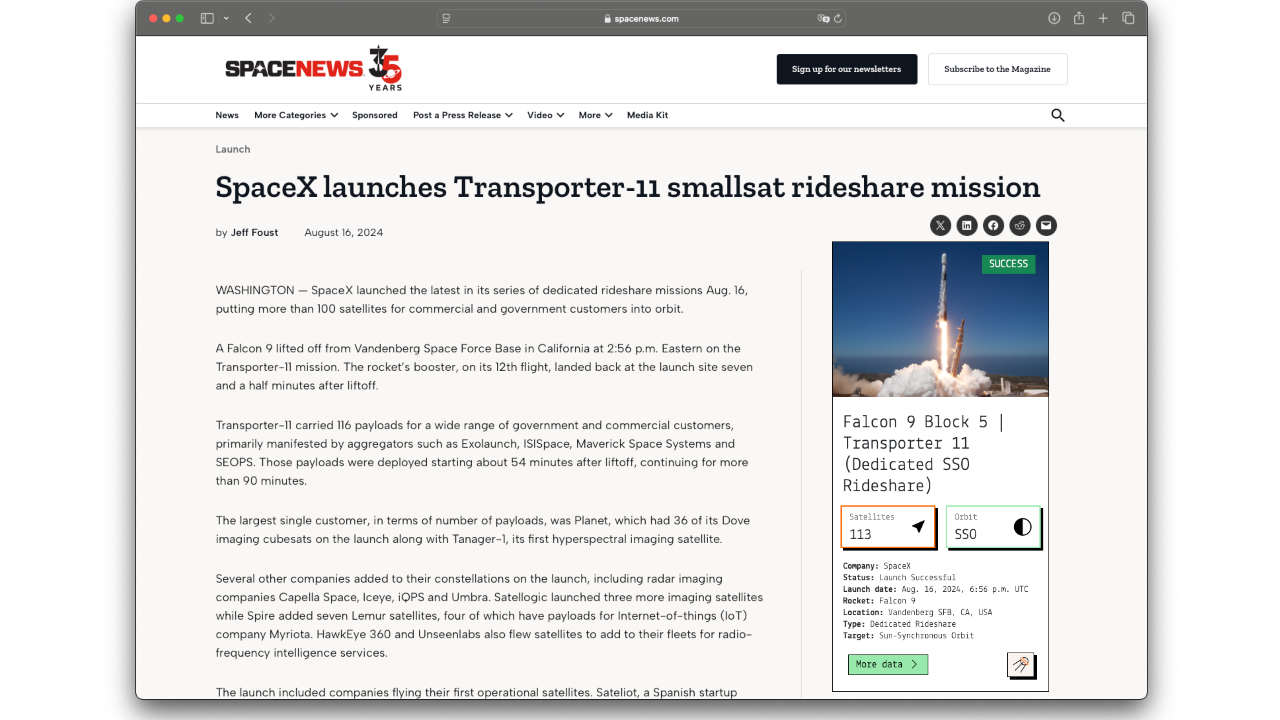
NOAA 11 was lifted into orbit during the mission ‘Atlas E | NOAA 11’, on board a Atlas E space rocket.
The launch took place on Sept. 24, 1988, 10:02 a.m. from Space Launch Complex 3W.
For more information about the launch, click the button.
Atlas E | NOAA 11
Agency: N/A
Status: Launch Successful
Launch date: Sept. 24, 1988, 10:02 a.m. UTC
Rocket: Atlas E
Launch pad: Space Launch Complex 3W
Location: Vandenberg SFB, CA, USA
...
Latest news about this satellite
There are no fresh news available about this satellite. Check back as we update our databases every day.

Newsletter sign-up
Weekly statistics, charts and insights to help you stay on top of the space industry.
