
Key statistics
Satellite VIASAT-3 F2 at a glance.
Uptime
29
Days in orbit
Revolutions
≈ 2.2
Per day
Orbit
MEO
Medium Earth Orbit
Inclination
5.5
Latest
Satellite identification and parameters
Extended collection of information and parameters for VIASAT-3 F2.
Object identification
Identified? True
Debris? False
Object name: VIASAT-3 F2
International designator: 2025-261A
Object number (NORAD): 66454
Object ID (CCSDS): 66454
Country: UNITED STATES OF AMERICA (US)
Current information (Y/N): Y
Orbital parameters
Period: 657.106 minutes
Inclination: 5.457 deg
SMA: 25037.093 km
Apoapsis: 24365.451 km
Periapsis: 12952.465 km
RAAN: 292.6501 deg
Eccentricy: 0.22792154
Argument of periapsis: 190.5469 deg
Mean anomaly: 204.5187 deg
Mean motion: 2.19142646 rev/day
Mean motion (dot): -0.00000081 rev/day2
B* drag term: 0.0 1/REarth
Two-line elements (TLE)
Creation date: Dec. 10, 2025, 10:40 a.m.
Reference frame: TEME
Reference center: EARTH
Epoch: Dec. 8, 2025, 12:11 p.m. UTC
TLE line 0: 0 VIASAT-3 F2
TLE line 1: 1 66454U 25261A 25342.50781694 -.00000081 00000-0 00000-0 0 9997
TLE line 2: 2 66454 5.4570 292.6501 2279215 190.5469 204.5187 2.19142646 557
Live tracking on map
Real-time ground track for satellite VIASAT-3 F2.
In-orbit conjunctions
There are no conjunctions computed for VIASAT-3 F2, at the moment. Check back to stay up to date, as we update our databases every day.
Go to all conjunctionsAssociated space launch
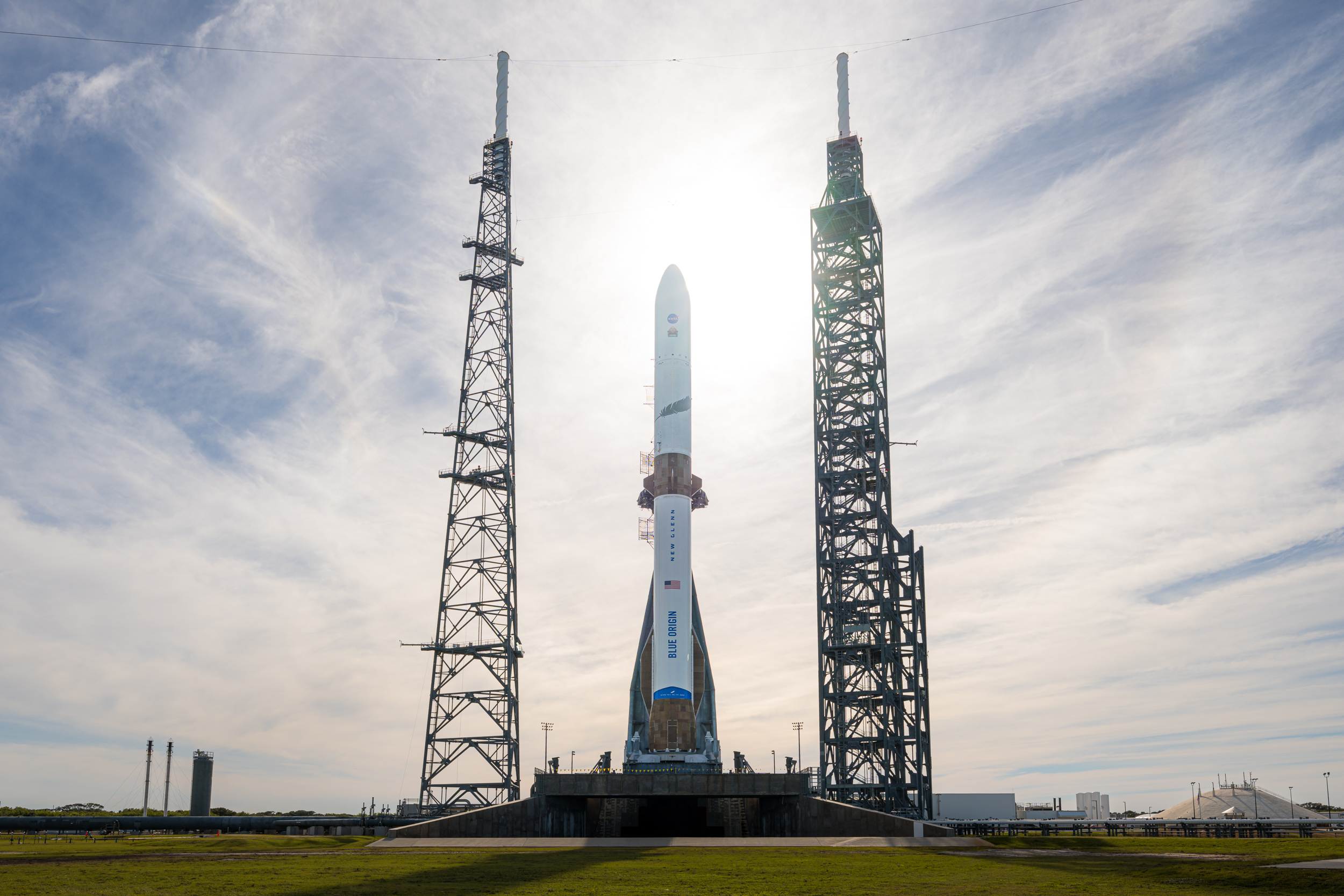
Second flight of Blue Origin's New Glenn launch vehicle carrying the Escape and Plasma Acceleration and Dynamics Explorers (EscaPADE), a dual-spacecraft mission from University of California, Berkeley to study ion and sputtered escape from Mars. The spacecrafts' scientific goals are to understand the processes controlling the structure of Mars' hybrid magnetosphere and how it guides ion flows; understand how energy and momentum are transported from the solar wind through Mars' magnetosphere; and understand the processes controlling the flow of energy and matter into and out of the collisional atmosphere.
VIASAT-3 F2 was lifted into orbit during the mission ‘New Glenn | EscaPADE’, on board a New Glenn space rocket.
The launch took place on Nov. 13, 2025, 8:55 p.m. from Launch Complex 36A.
For more information about the launch, click the button.
New Glenn | EscaPADE
Agency: N/A
Status: Launch Successful
Launch date: Nov. 13, 2025, 8:55 p.m. UTC
Rocket: New Glenn
Launch pad: Launch Complex 36A
Location: Cape Canaveral SFS, FL, USA
...
Latest news about this satellite

ESCAPADE spacecraft capture first images while en route to Mars
Washington DC (SPX) Nov 26, 2025 About a week after liftoff, the twin spacecraft of NASA's ESCAPADE mission returned their first images as they journey away from Earth. On November 21, one of the two spacecraft used its Visible and Infrared Observati...

Rocket Lab chief opens up about Neutron delays, New Glenn’s success, and NASA science
"In the end of the day, NASA has to capture the public's imagination."

Blue Origin's New Glenn Nails First Ocean Booster Landing
Maxwell AFB AL (SPX) Nov 18, 2025 Blue Origin's New Glenn rocket successfully made its way to orbit for the second time on Nov. 13, 2025. Although the second launch is never as flashy as the first, this mission is still significant in several ways. ...

Newsletter sign-up
Weekly statistics, charts and insights to help you stay on top of the space industry.
