
Key statistics
Satellite OBJECT A at a glance.
Uptime
24
Days in orbit
Revolutions
≈ 12.4
Per day
Orbit
LEO
Low Earth Orbit
Inclination
82.5
Latest
Satellite identification and parameters
Extended collection of information and parameters for OBJECT A.
Object identification
Identified? True
Debris? False
Object name: OBJECT A
International designator: 2025-273A
Object number (NORAD): 66647
Object ID (CCSDS): 66647
Country: COMMONWEALTH OF INDEPENDENT STATES (CIS)
Current information (Y/N): Y
Orbital parameters
Period: 115.947 minutes
Inclination: 82.4987 deg
SMA: 7876.476 km
Apoapsis: 1504.386 km
Periapsis: 1492.296 km
RAAN: 283.2629 deg
Eccentricy: 0.00076751
Argument of periapsis: 274.5556 deg
Mean anomaly: 85.4646 deg
Mean motion: 12.41952032 rev/day
Mean motion (dot): 0.00000019 rev/day2
B* drag term: 0.000064700535 1/REarth
Two-line elements (TLE)
Creation date: Dec. 18, 2025, 2:19 a.m.
Reference frame: TEME
Reference center: EARTH
Epoch: Dec. 17, 2025, 8:54 p.m. UTC
TLE line 0: 0 OBJECT A
TLE line 1: 1 66647U 25273A 25351.87105657 .00000019 00000-0 64701-4 0 9995
TLE line 2: 2 66647 82.4987 283.2629 0007675 274.5556 85.4646 12.41952032 2778
Live tracking on map
Real-time ground track for satellite OBJECT A.
In-orbit conjunctions
There are no conjunctions computed for OBJECT A, at the moment. Check back to stay up to date, as we update our databases every day.
Go to all conjunctionsAssociated space launch
Note: Payload identity and Cosmos series numbering not confirmed. The Strela (Russian: Стрела) are Soviet, then Russian, military space telecommunication satellites, in use since 1964. These satellites operate as mailboxes ("store-and-forward"): they remember the received messages and then resend them after the scheduled time, or by a command from the Earth. They can serve for up to five years. The satellites are used for transmission of encrypted messages and images. The operational constellation consists of 12 satellites in two orbital planes, spaced 90° apart. The spacecraft had a cylindrical body with a gravity-gradient boom, which was extended on-orbit to provide passive attitude stabilization. On-board storage was 12 Mbits of data, with a transmission rate of 2.4 kbit/s. The first three satellites were launched in 1964 by a Cosmos launcher. After one year of service, new and improved satellites were launched, called Strela-2. In 1970, these satellites were modernized, and became the Strela-1M and Strela-2M satellites. From 1985, these satellites will be gradually replaced by Strela-3, and then by Strela-3M from 2005. A civilian version of these satellites was created, called Goniets. Initially they were launched in groups of six on Tsyklon; when the launcher was retired, they were only launched by two on Cosmos, before Rokot was put into service and allowed the sending of triplets of Strela satellites.
OBJECT A was lifted into orbit during the mission ‘Angara 1.2 | 3 x Rodnik (Kosmos 2597, 2598, 2599)’, on board a Angara 1.2 space rocket.
The launch took place on Nov. 25, 2025, 1:42 p.m. from 35/1.
For more information about the launch, click the button.
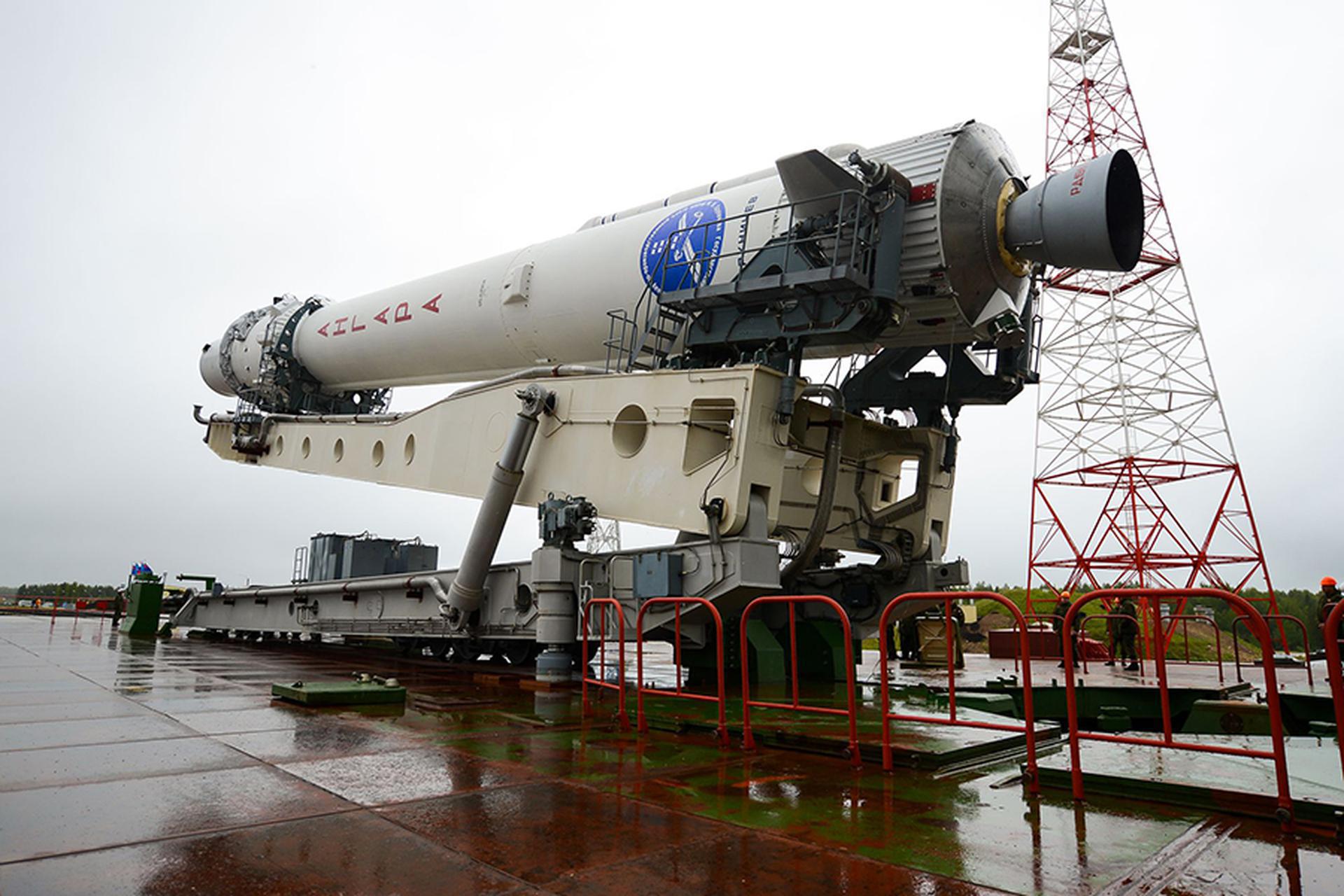
Angara 1.2 | 3 x Rodnik (Kosmos 2597, 2598, 2599)
Agency: N/A
Status: Launch Successful
Launch date: Nov. 25, 2025, 1:42 p.m. UTC
Rocket: Angara 1.2
Launch pad: 35/1
Location: Plesetsk Cosmodrome, Russian Federation
...
Latest news about this satellite

Launch Roundup: Soyuz to launch crew; Vega C and Falcon 9 to launch customer missions
A busy week ahead will see seven launches from five different rockets from across the… The post Launch Roundup: Soyuz to launch crew; Vega C and Falcon 9 to launch customer missions appeared first on NASASpaceFlight.com.

Newsletter sign-up
Weekly statistics, charts and insights to help you stay on top of the space industry.
